Free shipping on every order · 90-day guarantee · Made in Orange, California
The Picnic Blanket Cup Holder.com ← back to the picnic blanket page

The picnic blanket file

Why drinks tip over on a picnic blanket — and what actually holds one steady

A picnic solves for the food, the wine, and the walk from the car, and leaves the drink to fend for itself on whatever's underneath it once everyone sits down. Here's what's actually happening on the blanket, in the grass, and on the cooler lid, why the gear already sold for this scene keeps coming up short, and what it takes to hold a drink level once the spread is out.

The blanket isn't a table, it's a membrane

A tabletop holds its shape no matter what leans on it. A picnic blanket does the opposite — a soft top of fleece, polyester, or quilted cotton over a waterproof PEVA or polyester backing, none of it rigid on its own. Spread over a lawn, it behaves less like furniture than a stretched membrane: the standard extra-large size runs around 60 by 80 inches, sold to seat three to five adults, so several people's shifting weight can move one connected surface at once.

Kneel to pour a second glass and your knee compresses the fabric beneath it, pulling the whole blanket taut and changing the slope elsewhere on it — including under a cup a foot away that nobody touched. A drink on a picnic blanket rests on whatever shape the fabric happens to hold that second, a shape that rarely repeats twice in an afternoon.

The grass isn't flat either

Move the drink off the blanket and the ground isn't more cooperative. Mowed park lawn reads flat from standing height, but at ground level it's blades and thatch over soil that's rarely level to begin with — hidden divots, roots, drainage grading, the odd sprinkler head. A flat-bottomed cup set into grass never touches the soil; it rests on the thatch, at whatever small angle the grass allows, an angle that changes a foot to the left.

Stemware turns that small angle into a bigger one. A wine glass's only contact with the ground is its foot, under a full bowl, and in grass the stem acts exactly like a lever: a tilt at the foot multiplies by the time it reaches the rim. It's why a whole accessory category exists purely to keep stemware upright outdoors, and their own listings open with tipping and spilling first.

Why the ground fights back hardest in picnic season

There's a second failure mode that shows up only at the height of the season. Park lawns and the bare dirt at their edges bake hard and dry by mid-to-late summer, and anything that anchors by pushing a spike into the ground depends on that ground accepting the spike — the same penetration-and-friction physics documented to fail tent stakes in packed, dry earth. A baked lawn is too uneven to stand a glass on and too hard to drive anything into at once, so the exact stretch of summer when picnics peak is the stretch when the ground gives an anchor the least to work with.

Wondering about your specific cup? The fit database has sourced base measurements for 30+ containers — Stanley, Red Bull, Yeti, and the honest no's.

The slope nobody notices until something rolls

Add elevation and the problem changes shape again. Amphitheater lawn seats are graded on purpose, for sightlines — the standard layout at venues that build full picnicking into the show, like Ravinia Festival outside Chicago, which lets ticket holders bring a full meal and alcohol onto the lawn, and the Hollywood Bowl, whose rules welcome outside food and, at most LA Phil shows, wine and beer. Even parks that ban the classic picnic make the same point differently: Central Park's Sheep Meadow, a 15-acre lawn drawing roughly three million visitors a year, bans glass bottles outright — part of why picnic drinks show up in cans and plastic cups instead, both easier to knock over than glass.

On a graded lawn, a drink is already leaning downhill before anyone touches it. Knock it there and it doesn't just tip in place — it rolls, and between sets after dark, a can left in the grass at the blanket's edge is invisible until a passing foot finds it.

What people already bring, and where each one runs out

A small industry already exists to answer this, each piece solving a narrower slice than its listing photo suggests.

Metal wine and drink stakes — Picnic Stix, Steady Sticks, Sorbus, and close copies — push a spike into the ground below a glass ring, the same physics that fails a tent stake: soil has to grip the spike, and picnic-season ground either won't (baked hard) or grips too loosely (soft dirt lets it lean). Most sets hold stemware and a bottle only, leaving cans and kids' cups homeless, and common stem heights cluster around 32 to 36 inches — chair height, well above anyone sitting cross-legged on a blanket.

Folding bamboo wine tables — Tirrinia, Peohud, and Piticco among the common listings — fold out with slot cutouts for four hanging glasses. Reviews describe wobble on sand and uneven grass, and sellers themselves concede the tables do best on flat, stable surfaces the lawn never offers.

The muffin-tin hack, recycled through picnic-hack roundups for years, only works if what's in hand matches a well's size, and the rigid tin rocks as a whole on lumpy ground, tipping every cup together. Suction "anti-spill" coasters need a smooth, hard, clean surface to seal against, so on fabric or turf the suction never engages. Sand spikes carried over from the beach hit the same wall from another angle — built for loose sand, not turf or packed soil.

What actually holds one, base up

Every fix above solves only part of the problem: a stake needs cooperative soil, a table needs flat ground, a muffin tin needs cups that match its wells. None handles the surface without help — each needs the surface to already be right, which a blanket picnic never is.

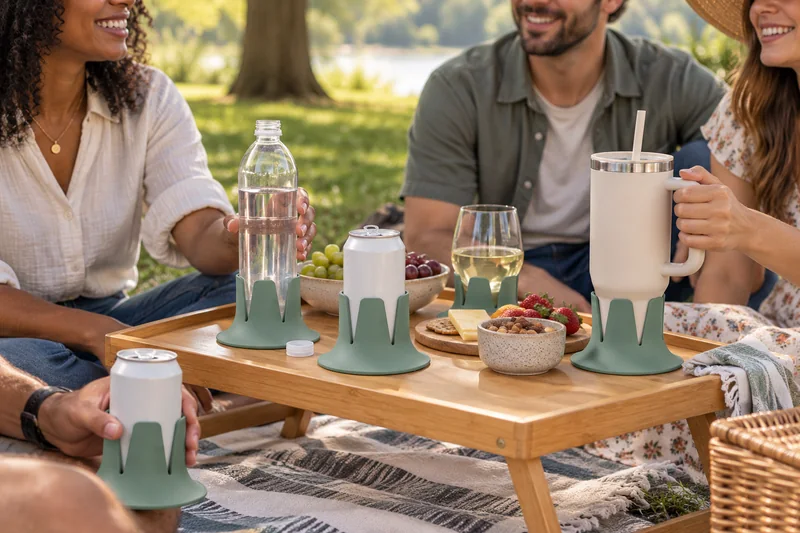
What matters is footprint, weight, and grip, in that order. A wide base spread across slack fabric or lumpy turf distributes weight instead of concentrating it on one point, the way a stake or a wine glass's foot does — and because that weight sits low, a dip in the fabric doesn't have enough leverage to tip it. Flexible fins then hold a container by its bottom inch instead of a slot sized for one shape: a 12 oz can runs about 2.6 inches at the base, a slim seltzer nearer 2.25, a standing wine bottle closer to 3, and a 40 oz Stanley tumbler measures a founder-verified 3.1. A base of 2 to 3 inches settles in fully, and the fins flex to seat bases as wide as 3.15, snugly, just past that. Kneel for the board, let a kid cross the blanket, bump the slope — the low, wide base resists tipping instead of amplifying whatever just moved.

None of it requires planting a spike in dirt that won't take one, or unfolding a table sized for ground you don't have. It just takes a base wide enough for whatever the blanket is doing underneath it, and fins that hold on to whatever's actually in your hand — so the glass that goes down at golden hour is still standing when the light's gone.

Pick your pack — ships free

Buying happens at steadilabs.com — the company that molds it.